
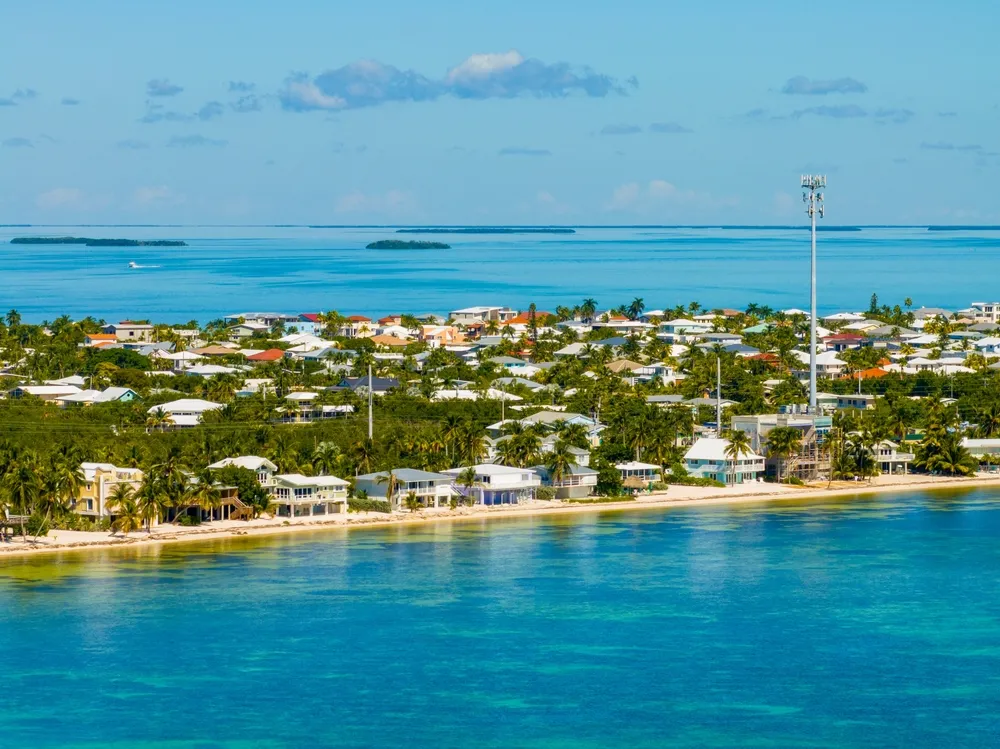


A real estate market where sales, prices, and shrinking inventory all point upward should be one where homes sell faster. In the Florida Keys, the opposite is happening. Through the first eight months of 2026, sales across every Keys submarket are up 11% year over year, according to Lisa Ferringo, who leads the Lisa Ferringo Group and has worked the Keys market since relocating from Miami. Average sale prices are up 9.9%. Inventory is down 10.7% from this time last year. Yet days on market are surging; in Key West, that figure is up 57%.
The explanation, Ferringo says, is straightforward: well-maintained, properly priced homes draw multiple offers and sell fast, while everything else sits. “If you’re not priced right, if you’re not pretty, if you don’t have a good location, they’re staying on the market a long time,” she says. “If you have just a jewel of a house, multiple offers, it’s gone.”
That split between desirable and undesirable inventory is shaping nearly every aspect of the market, from who is buying to what they will pay and what they refuse to touch at any price.
A Different Buyer Than Five Years Ago
Before COVID, roughly half the buyers in the Keys came from within Florida, many of them younger couples with children looking for a weekend or summer house. A waterfront home could be had for around $450,000, with a mortgage payment of roughly $3,500 and manageable insurance and tax costs.
That buyer has largely disappeared. Monthly payments on comparable properties have climbed to $6,500 or $7,000, according to Ferringo, pushing young Florida families out of the market. The buyers replacing them are retirees and near-retirees from the Midwest, farmers, small business owners, company owners, along with buyers from Mid-Atlantic states like New Jersey, Maryland, and Delaware, and more affluent Floridians.
About 90% of sales through the Ferringo Group are second homes or investment properties. The market caters to a specific lifestyle. “We don’t have nightclubs; we don’t have really shopping,” Ferringo says. “It’s all fishermen, water sports, divers.”
Five Markets, Not One
The Keys stretch 120 miles from the mainland to Key West, connected by 42 bridges, and each submarket draws a distinct buyer profile. Islamorada attracts sport-fishing buyers and commands the highest prices. Marathon and Key Colony Beach are where investors go for short-term rental income; those areas allow seven-day rentals, while most of the rest of the Keys require a 28-day minimum. The Lower Keys offer privacy and rural character at the lowest prices. Key West draws buyers seeking arts, culture, and music.
Geography shapes buyer behavior in practical ways. Florida-based buyers, especially those from Miami, tend to stay north of Seven Mile Bridge to minimize the drive. Buyers who fly in are more open to the full range. Ferringo recounts selling a Montana rancher on a Lower Keys property, nearly an acre on open water, after the buyer initially insisted on Islamorada. The privacy and rural setting won out. “You could literally go down the street with $800,000 houses till you come to the end to this beautiful $12 million house,” she says.
Construction Costs and a Building Moratorium
Building codes in the Keys require structures to withstand 180-mile-per-hour winds, the highest wind load standard in Florida. Concrete construction is preferred at higher price points, but costs start at $700 per square foot and reach $1,200 for a high-quality build. Modular homes run $200 to $250 per foot.
Labor shortages and the cost of transporting materials compound the expense. Ferringo cites a client on Sugarloaf Key who received a quote of $1 million to add a roughly thousand-square-foot master suite, without going up a story.
The Keys are currently under what amounts to a building moratorium, with no new permits expected for at least a year. That constraint makes teardowns and fixer-uppers more valuable as acquisition targets, though renovation carries the same cost challenges. Buyers generally do not want to manage construction remotely. “No one wants to come down here and do work,” Ferringo says. “They want to go fishing.”
Insurance Splits the Market in Two
Insurance costs affect mortgage-dependent and cash buyers in fundamentally different ways. Citizens, Florida’s insurer of last resort, will not write policies on homes with replacement costs above $1 million, according to Ferringo. That forces buyers of higher-value properties to seek coverage from outside carriers at significantly higher premiums. For mortgage-dependent buyers, those costs compound with elevated interest rates, a combination that causes deals to fall apart when buyers see the full carrying costs.
Cash buyers at the upper end face a different calculus. Some opt to self-insure entirely, carrying no wind or flood coverage on concrete-built homes. The result: the mortgage-dependent segment is struggling while the high end stays active. “The higher range is doing very well right now,” Ferringo says. “The mortgage-dependent market, the lower end, is struggling a little bit because interest rates are at 7%.”
Where Investors Are Looking
For investors seeking rental income, Ferringo points to Marathon and Key Colony Beach, where weekly rentals are permitted, and strong properties can achieve roughly 46 weeks of occupancy per year. Fix-and-flip opportunities exist but are scarce, partly because of high renovation costs and partly because the building moratorium makes any property with an existing structure more valuable.
Investor sentiment is cautious. “Our investors are very sensitive to interest rates,” Ferringo says. “And now that they just hit seven, that’s definitely put a little bit of a damper on the investor market.”
Condition at Listing Is the Dividing Line
The gap between the Keys’ healthy aggregate statistics and the ground-level reality comes down to condition and pricing. Dated properties from the 1980s on canals, two or three bedrooms, needing work, are available in volume and sitting for months. Updated homes built to current standards, with good views and modern finishes, are moving quickly. For sellers weighing whether to invest in updates before listing, the market is drawing a clear line: properties that meet today’s buyer expectations sell; those that do not will wait until their price reflects the gap.
About the Expert: Lisa Ferringo leads the Lisa Ferringo Group, covering the Florida Keys market since relocating from Miami.
This article is based on information provided by the expert source cited above. It is intended for general informational purposes only and does not constitute legal, financial, or real estate advice. Readers should conduct their own research and consult qualified professionals before making any real estate or financial decisions.