
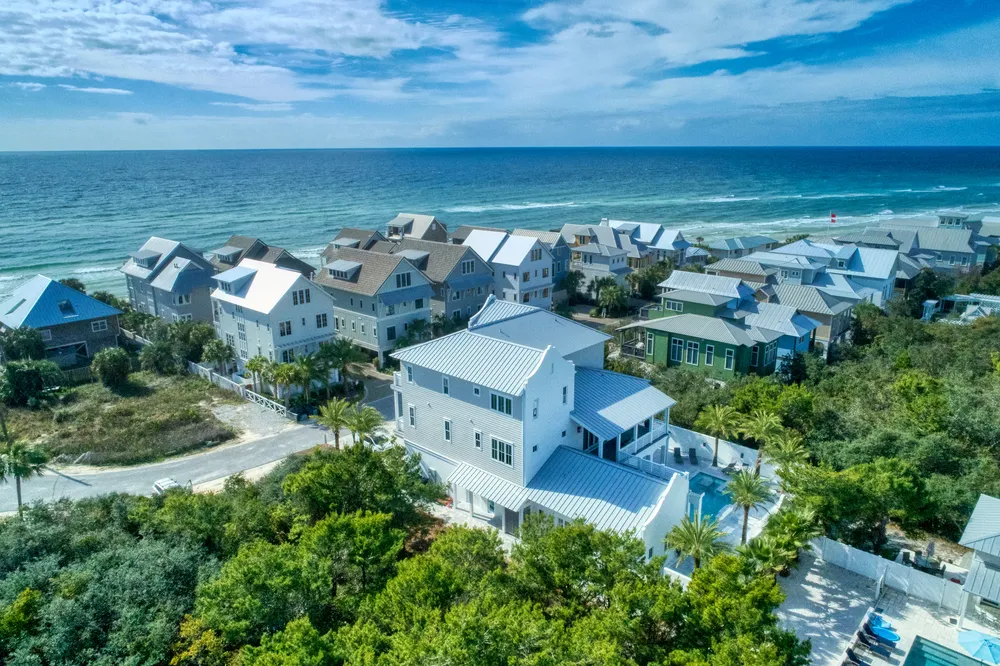


Along Florida’s Gulf Coast, a 26-mile stretch of shoreline known as 30A has quietly attracted a different kind of wealth. What was once a regional drive-to destination for families from Atlanta, Nashville, and Birmingham has become a legitimate luxury investment market, with properties now trading at values comparable to Palm Beach or Aspen. For Bob Dickhaus, who founded Dune Vacation Rentals in 2013, this growth has been gradual but unmistakable, and it is reshaping how high-end vacation rental management operates in the area.
Before the pandemic, 30A’s appeal was largely regional. The area’s white quartz-sand beaches and Caribbean-blue water were well known to Southeast travelers, but less so to buyers from the coasts or the Midwest. Florida’s early reopening during COVID drew visitors from states with stricter restrictions, and many discovered the area for the first time.
That discovery translated into ownership. The investor profile on 30A has broadened considerably, moving from primarily regional second-home buyers to a more diverse mix that now includes family offices, entrepreneurs, and professional athletes. Dickhaus describes the emerging demographic as younger and more entrepreneurial than the established-money crowd typically associated with Palm Beach. The company was among the first to position 30A as the “Palm Beach of the North,” a framing that reflects both the caliber of properties now being built and the type of buyer entering the market.
Serving the Top 5%
Dune operates exclusively at the high end. The company’s average managed property is valued at around $4.5 million, and its portfolio extends up to $40 million. By design, 95% of homes in the area do not meet the company’s criteria. That selectivity is central to the business model.
Dickhaus avoids condos almost entirely because units within a single building tend to look alike, forcing operators to compete on price rather than distinctiveness. Properties that stand out – whether through location, design, or amenities – can command rates reflecting their uniqueness. Some gulf-front homes on Dune’s roster generate $75,000 per week in rental income during peak periods.
The owner base spans a range of motivations. Second-home buyers want to offset carrying costs by renting out their homes when they are not in residence. Professional investors treat these properties as yield-generating assets, combining rental cash returns, typically between 4% and 10% of purchase value annually, with long-term appreciation. A $10 million property generating $1 million in rental income and appreciating has attracted family offices seeking tangible, experience-adjacent assets.
What Owners Underestimate
Managing a luxury coastal property is more demanding than many first-time owners anticipate. The salt air and humidity that make 30A attractive to guests also accelerate wear on mechanical systems, finishes, and structural components.
Dickhaus notes that owners unfamiliar with waterfront environments often don’t realize that air conditioners and other mechanical systems require more frequent servicing or have shorter lifespans. “Preventative maintenance is important, and we try to educate all of our owners that it’s an important component of doing business,” he says.
Beyond routine upkeep, capital planning catches owners off guard. Dune’s asset management approach includes proactive assessments of when roofs will need to be replaced, when flooring should be refinished, and when equipment upgrades are necessary. The company advises owners to budget between 3% and 5% of operating costs annually for replacements and upgrades.
Maintaining brand standards adds another layer. Guest reviews occasionally flag specific items – a worn mattress, tired furniture in a common area – and Dune communicates those findings to owners. Properties that fall behind on upkeep risk negative reviews, which directly affect future bookings and pricing power.
Rethinking the Guest Experience
High-end vacation rental guests increasingly expect hotel-caliber service within a private home setting, a trend that prompted Dune’s most recent service evolution, Dune Estate Services.
The model includes fully provisioned kitchens and medicine cabinets, daily housekeeping, and access to in-home concierge services ranging from private chefs to yoga instructors to live music. This draws on an international hospitality standard that guests accustomed to villa rentals in Mexico or the Caribbean already expect as baseline. Dickhaus says Dune was the first to bring this model to the 30A market.
A companion service, Dune In Home, offers curated experiences within the property itself. For guests traveling with large groups or families, bringing hospitality services to them – rather than navigating crowded restaurants during peak season – has clear appeal.
This orientation toward guest experience is also a business strategy. Dune tracks satisfaction through an internal system called Raving Fans, targeting five-star reviews across platforms. Over five years, the company has accumulated more than 4,000 reviews with an average rating of 4.8 out of 5, supporting repeat bookings and long-term pricing stability.
On Regulations and Pricing Strategy
The national conversation around short-term rental regulation has been loud, but Dickhaus offers a measured read of what it means for established operators. Rules like Walton County’s mandatory one-hour response time for guest issues are standard practice for a company with on-the-ground infrastructure. The regulations have, however, raised the barrier to entry for individual owners self-managing through platforms like Airbnb or VRBO, consolidating demand toward professional operators.
On pricing, Dune takes a deliberate approach. The company uses Key Data, an industry benchmarking tool, to track comparable properties and adjusts rates manually rather than relying on automated dynamic pricing systems. Dickhaus avoids heavy discounting because it attracts less-compatible guests and trains customers to wait for deals, undermining its long-term pricing power.
AI and the Next Phase of Search
The way guests find vacation rental properties is changing. Search behavior is moving from keyword-based queries toward conversational, context-rich prompts. A guest might ask an AI assistant for a property within 200 yards of the beach near a specific event on a specific weekend, and results will increasingly reflect that kind of nuanced matching.
Dune is investing in what Dickhaus calls the “AI plumbing” behind its website content, structuring information so it surfaces accurately in AI-generated results. The company is already seeing early returns, with Dune appearing in AI-curated recommendations for 30A rentals on platforms like Google.
“AI is not going to replace search, but it’s going to become a larger component of search,” he says. “That’s consumer-driven, by their use of Claude or ChatGPT or whatever AI system they’re comfortable with.”
For a market that has spent the past several years attracting a new class of investor, the next challenge is visibility, reaching buyers and guests who may not yet know that 30A exists, but whose preferences, once described to an AI assistant, would point them directly to it.
About the Expert: Bob Dickhaus is Founder of Dune Vacation Rentals, a luxury property management company he established in 2013 along Florida’s 30A corridor, managing properties valued from $4.5 million up to $40 million.
This article is based on information provided by the expert source cited above. It is intended for general informational purposes only and does not constitute legal, financial, or real estate advice. Readers should conduct their own research and consult qualified professionals before making any real estate or financial decisions.