
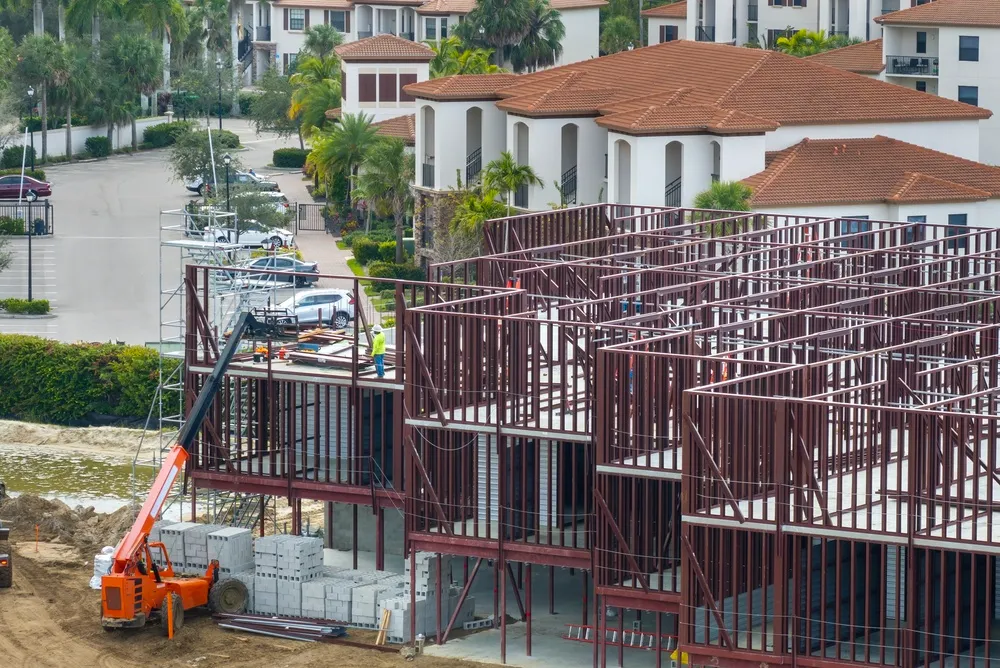


Developers across Northeast Florida are still struggling to reconcile current construction costs with the numbers they used to finance and approve projects five years ago. But according to at least one architect working in the region, the frustration may stem from using the wrong baseline. The buildings being built today are fundamentally more complex than what was being built in 2019 – and that complexity, driven by Florida’s climate demands and evolving building codes, carries real cost.
Conner Dowling, principal and founder of Open City Architecture in St. Augustine, says the sharp cost jump that began around 2020 has not reversed, but it has stabilized. More importantly, Dowling argues that a portion of the increase reflects genuine value rather than pure inflation – specifically, the additional engineering and design work required to build structures that can withstand flooding, hurricanes, and the long-term effects of Florida’s climate.
“It takes a lot here in our market specifically to create a building that is not going to flood, that’s safe, that’s sustainable,” Dowling says. “Building code safety and regulations change and create costs to go up, frankly. But it should be a return on your investment in longevity and building safety.”
The 2019 Baseline Problem
The most common source of friction Dowling observes between clients and construction realities is the habit of comparing current costs to pre-pandemic figures. Developers and property owners who built projects in 2018 or 2019 carry a mental model of what construction should cost, and current numbers look irrational by comparison.
“A lot of people look at their spreadsheets, go back to 2019, and look at what they used to be able to build, and they look at it now, and they’re just like, how can this be,” Dowling says.
His position is that this comparison conflates two different products. A building designed and constructed in Northeast Florida today must meet more stringent requirements than its 2019 equivalent – not because of regulatory overreach, but because the risks are better understood and the consequences of underbuilding are more visible. Flood mitigation, hurricane resilience, and sustainability standards have all become more demanding, and each adds cost.
Where the Cost Pressure Is Most Acute
Beyond code requirements, the physical characteristics of remaining buildable land are adding another layer of expense. Dowling notes that the challenge is particularly pronounced on sites that present environmental complexity – low-lying parcels, waterfront locations, and areas with poor drainage. Northeast Florida has seen significant development on its most accessible land, leaving a remaining inventory of parcels that need more extensive land preparation. A developer acquiring one of these sites may discover that the cost to build safely is substantially higher than a comparable project on a simpler parcel.
This dynamic is compounding the affordability pressure already created by elevated materials and labor costs. Even as supply chain volatility has eased since its peak, the baseline cost of building in Florida has not returned to pre-pandemic levels. Dowling says the stabilization is real, but the level at which costs have settled is permanently higher than what developers were accustomed to.
“It was the hardest part – the size of the jump from 2019 to 2020,” Dowling says. “Since then it’s way more even, but everything’s just gone up.”
Designing Within the New Reality
Rather than waiting for costs to decline, Dowling’s firm has adapted its process to work within current pricing constraints more deliberately. Open City Architecture approaches projects by establishing clear goals with clients upfront and then aligning design decisions to meet those goals within realistic budgets. Dowling says this requires architects to be skilled at value engineering – finding cost savings in some areas to preserve quality in others – rather than simply designing and leaving cost management to contractors.
“We say, okay, we have a realistic amount of money to spend – what can we do with it,” Dowling says. “We create goals for the project and achieve those goals, and we’ll be able to align with the budget.”
This approach positions the architect as a financial collaborator rather than a purely creative role, a framing that Dowling says reflects how he was trained to practice. He argues that a skilled architect should be able to extract more value from a given construction budget than a less experienced one – not by cutting corners, but by making smarter decisions about where to invest and where to simplify.
For Northeast Florida’s development community, the broader implication is that the path forward does not await cost normalization. Still, developers should adjust their expectations and financing plans to reflect the actual cost of building durable, safe structures in a challenging climate. Whether developers broadly adopt that recalibration – or continue to defer projects in hopes of a cost correction – may shape the region’s development pipeline for years to come.
About the Expert: Conner Dowling is founder of Open City Architecture, a boutique design firm based in St. Augustine, Florida, with a practice spanning custom residential work, hospitality, institutional commissions, sports facilities, and municipal projects across Northeast Florida.
This article is intended for informational purposes only and does not constitute legal, financial, or investment advice. The views and opinions expressed herein reflect those of the individuals quoted and do not represent an endorsement of any company, product, or service mentioned. Readers should conduct their own due diligence and consult qualified professionals before making any investment decisions.