
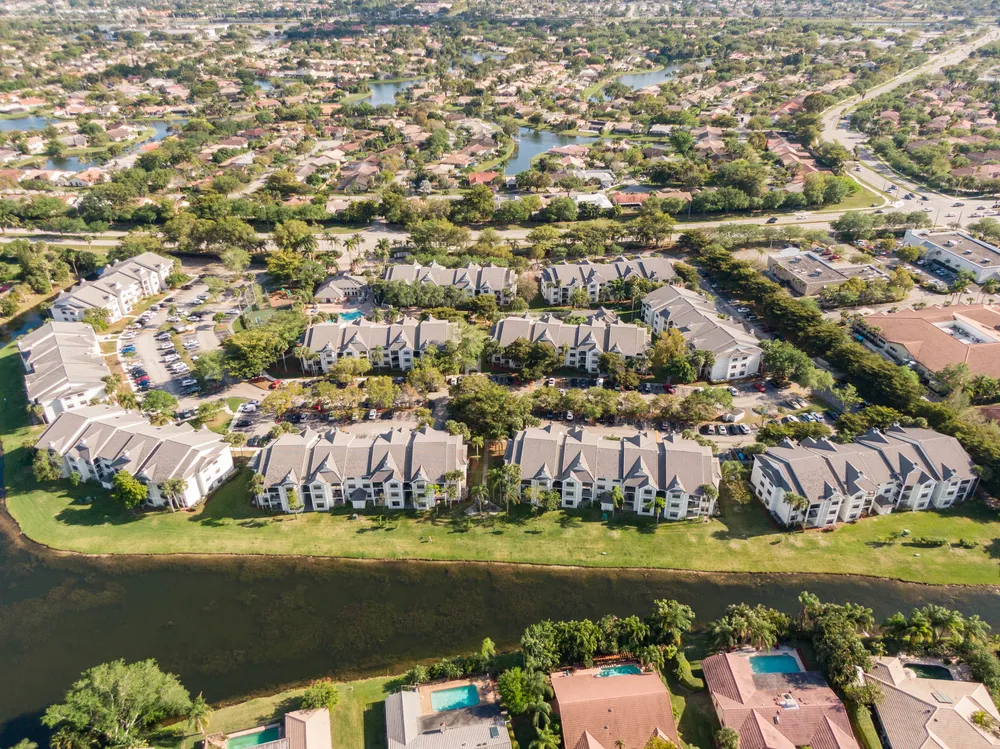


Insurance cost increases and new reserve requirements have pushed monthly HOA fees in some South Florida condominium buildings from under $300 to more than $650 – a change that is forcing fixed-income retirees to sell properties they intended to keep for life, while simultaneously making those same condos nearly impossible to finance for incoming buyers.
The pressure stems from two overlapping forces: insurance premiums that roughly doubled across many condo associations beginning in 2022 and 2023, and updated structural safety legislation that now requires buildings to maintain funded reserves and complete milestone inspections. Together, these have reshaped the economics of condo ownership in ways that interest rates alone cannot explain.
According to Joel Freis, Associate Broker at Compass Real Estate, the condo market in South Florida has become structurally different from the single-family market. The problems are embedded in the financing rules, reserve requirements, and insurance dynamics that now govern how condominiums are bought, sold, and held.
“It started about a year and a half, two years ago, when insurance rates doubled for these condos,” Freis says. “Many of the 55-and-over buildings had HOAs of under $300 or right at $300. All of a sudden they jump up to $650 a month.”
Fixed-Income Owners Squeezed
The financial math for retirees in affected buildings has become untenable. A pattern is playing out repeatedly across South Florida’s older condo stock: a buyer who purchased seven or eight years ago, on a fixed income, assumed the property would be their final home. Monthly costs were manageable. Then insurance rates spiked, reserve requirements tightened, and HOA fees surged.
For someone drawing $2,000 to $3,000 monthly from Social Security, an additional $300 to $400 in monthly carrying costs – on top of any tax increases – can make the property unaffordable to hold.
“If you’re on a fixed income, you’re thinking it’s going to be your final home,” Freis says. “You maybe got $2,000, $3,000 a month from Social Security coming in, and now you have an additional $300, $400 a month payment. It really puts a hurting on these people.”
The result is a forced-seller dynamic in a market where buyers are already cautious. Owners who need to exit are competing against each other in a pool of buyers that has been significantly narrowed by financing constraints.
Financing Barriers Shrink Buyers
While more owners are being pushed to sell, the buyer pool that could absorb their units has shrunk considerably. Freis notes that condos and single-family homes are now operating as two entirely separate markets, with the financing gap between them as the primary driver.
Single-family homes remain accessible to a wide range of buyers through FHA loans, VA loans, and conventional mortgages with as little as five percent down. Condominiums, by contrast, require larger down payments – and in some buildings, financing is not available at all.
“Condos are more difficult to finance,” Freis says. “You have to put a larger down payment, and even then, some of them are not financeable, because maybe they have pending structural inspections or pending construction being done to bring it into current market code.”
Lenders are declining to extend credit on buildings with unresolved structural questions or depleted reserves – precisely the buildings where HOA fees have risen most sharply. The buyers who can purchase in these buildings are cash buyers, a smaller and more selective pool. This compresses demand at exactly the moment when supply from motivated sellers is increasing.
Listings Stretch to 12 Months
These converging pressures are producing a bifurcated seller pool. The condo market is not uniformly slow – it is sorting itself by seller motivation and building-level financing accessibility.
Motivated sellers, typically those with a genuine financial need to exit, are pricing aggressively. Some are accepting losses. Freis recently handled a condo transaction in Homestead where the seller owed more than the property could fetch on the market. The seller had the personal funds to cover the shortfall and wrote a check to the bank at closing – a transaction that technically should have been a short sale.
Unmotivated sellers, those holding out for a price that reflects what they paid or what the market offered two years ago, are sitting. Some are pulling listings entirely rather than accepting lower offers.
“Some sellers are holding out on their price, holding firm, and so they’re going to sit longer on the market,” Freis says. “They might go 12 months on the market, or a lot of the time they just pull it off.”
The 12-month figure is not universal. Buildings with stronger financing profiles – those that have completed required inspections, maintained adequate reserves, and retained lender approval – are moving faster. The market is sorting by building quality, not by geography alone.
A Multi-Year Recovery Ahead
Freis does not view the condo situation as permanently impaired. His assessment is that the structural problems are real but solvable – they simply require time that many current owners do not have.
Buildings need to rebuild reserves, which takes years of elevated HOA fees. Structural work needs to be completed and inspected. Lenders need confidence that the physical and regulatory condition of buildings is stable before they will extend normal financing terms. Insurance markets need to stabilize.
“I do think a lot of it’s going to work out,” Freis says. “Two to three years from now, you’ll see the buildings will have their HOAs caught up, the repairs will be paid for, the loans paid off, and hopefully they’re able to bring the association fees back down a little bit.”
Freis and his partner Denise Madden have been navigating these conditions by helping sellers understand realistic pricing and connecting buyers with buildings that retain financing eligibility. The ability to distinguish between a building that is temporarily distressed and one with deeper structural or financial problems has become essential for agents working in this segment.
For the broader South Florida condo market, the path forward runs through reserve fund recovery and insurance stabilization – neither of which is on a short timeline. Until those conditions are met, the financing gap between condos and single-family homes is likely to persist, keeping cash buyers the dominant force in a market built for financed transactions.
About the Expert: Joel Freis is an Associate Broker at Compass Real Estate, with more than two decades of experience working through multiple market cycles in South Florida.
This article is intended for informational purposes only and does not constitute legal, financial, or investment advice. The views and opinions expressed herein reflect those of the individuals quoted and do not represent an endorsement of any company, product, or service mentioned. Readers should conduct their own due diligence and consult qualified professionals before making any investment decisions.