
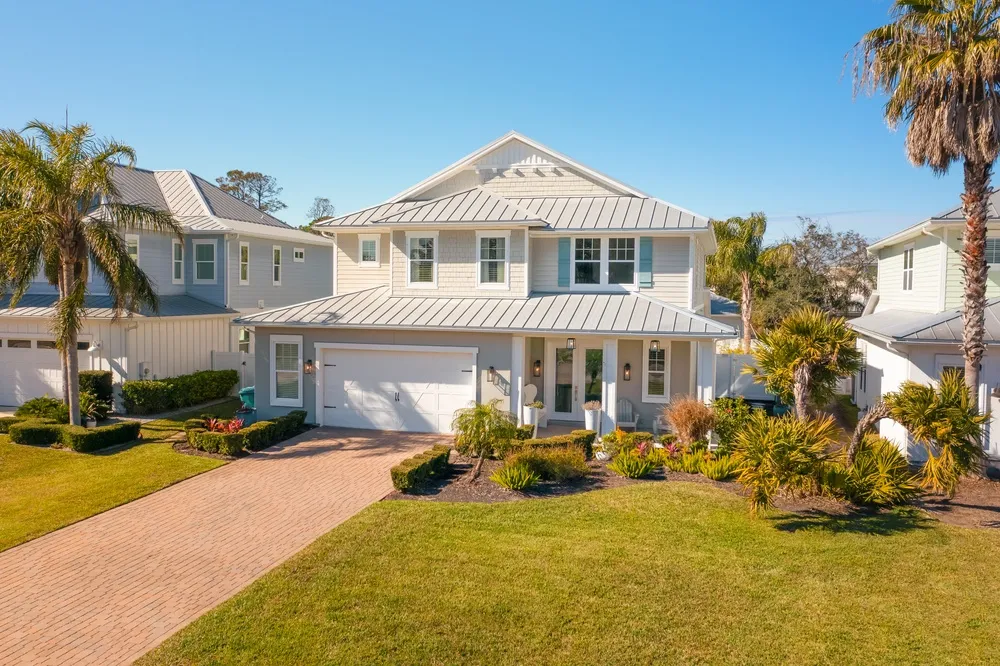


National real estate coverage has spent much of the past year warning about rising foreclosures and cooling conditions across Florida. In northeast Florida, those warnings do not match the data on the ground, according to Christina Welch, Owner & Team Leader of the Welch Team at Keller Williams St. Johns. Foreclosures and sales where the home sells for less than what’s owed on it account for just 1.5 percent of total closings in her market. She considers that figure too small to support the distress narrative. The area remains a seller’s market. Welch says multiple-offer situations were still occurring as of late July 2026.
“It’s only one and a half percent of our total closings in Northeast Florida, which is not a lot,” Welch says.
The gap between national narrative and local reality carries practical consequences. Investors, relocating buyers, and agents who rely on national data may misprice offers, miss opportunities, or make poorly timed decisions in a market that is behaving differently.
National Data Misses Growth
Northeast Florida’s growth trajectory diverges sharply from the national average. Welch says 80% of the roughly 1,000 people per day moving to Florida during the pandemic-era surge were coming to northeast Florida. That demographic pressure created supply-and-demand conditions unlike markets experiencing stagnation or contraction.
“The national statistics don’t necessarily keep up with what’s happening locally,” Welch says. “We have to hyper-focus on communities, not only counties, but even neighborhood-specific, on what’s going on in that specific community.”
National indices are built on averages, and averages obscure extremes. Population growth still drives demand in this market, and new highways, hospitals, and schools are being built to accommodate it. That market may be trending in the opposite direction from the national average even as that average signals weakness.
A Hidden Seller’s Market
As of mid-2026, most segments in northeast Florida still favor sellers. Welch says there are only enough homes for sale to last about four months at the current pace of sales, and pricing is trending upward, with prices up about 5% from a year ago.
“If you look at our local area, we’re still hovering in a seller’s market,” Welch says. “There are multiple properties; even this past week, we had multiple offers that took place.”
The market is not without nuance. Welch acknowledges pockets of elevated inventory, particularly in areas with heavy new construction, where some neighborhoods behave more like buyer’s markets. But she frames these as localized conditions rather than evidence of broad deterioration.
Builders Challenge Existing-Home Sellers
Owners selling existing homes face direct competition from builders, who offer incentives such as lower interest rates, closing cost assistance, and design center upgrades that individual homeowners cannot easily match. Welch says sellers who price alongside new construction often need to offer their own discounts or incentives to attract buyers, particularly when their homes do not look new.
“The concessions are helping the property stand out,” Welch says. She adds that offering discounts or added extras is now more common than cutting the price, as long as homes are priced accurately from the start.
Properties that sit for extended periods share two characteristics, according to Welch: they are priced too high, and they do not show well. Sellers who fix both issues before listing avoid a cycle of price cuts and homes sitting unsold for a long time, both of which erode their negotiating position.
Unsold Listings Skew Data
One factor Welch says contributed to a temporary leveling off was a jump in homes listed for sale but never sold and then pulled off the market. These were properties priced aggressively by sellers testing the market without a real need to move.
“We’re also seeing people who wanted to test the market to see if they could get a price. They don’t really need to move,” Welch says. “Those people are expiring their properties currently.”
When unmotivated sellers list at aspirational prices and then withdraw without selling, they inflate the count of homes for sale and make it look like homes are sitting unsold for longer than they really are. National analysts use both figures to judge how healthy a market is. For readers relying on statewide or national data to assess northeast Florida, headline inventory figures may overstate actual softness.
Buyers Accept Higher Rates
Buyers in northeast Florida are more cautious than a year ago, according to Welch. Many are still adjusting to current interest rate levels. She says buyers have begun accepting that 6% represents the new baseline after years of hoping for a return to pandemic-era rates near 3%.
“It’s taken some time for them to come to terms with where rates stand,” Welch says. Sellers and agents who present all cost information upfront, including closing cost assistance options, help buyers move past rate hesitation. This allows buyers to make decisions based on their total monthly cost of owning the home rather than the advertised interest rate alone.
What Neighborhood Data Reveals
Welch’s response to the gap between national narrative and local reality is to track conditions at the neighborhood level rather than relying on county or metro-wide statistics. Her team covers four counties in northeast Florida with 12 selling agents plus dedicated transaction and marketing staff.
“You have to take it neighborhood by neighborhood,” Welch says. Factors as specific as whether a community has an activities director, the quality of the school district zone, or the presence of competing new construction within that neighborhood all affect how individual properties perform. None of these factors appear in national data sets.
For buyers and sellers in northeast Florida, the practical implication is direct. Decisions based on national trend coverage risk being months behind, or entirely wrong, about what is actually happening in the specific neighborhood where the transaction will occur.
About the Expert: Christina Welch is Owner and Team Leader of the Welch Team at Keller Williams St. Johns, leading the largest residential team in northeast Florida with 12 selling agents and a commercial division, closing approximately five homes per week across four counties.
This article is intended for informational purposes only and does not constitute legal, financial, or investment advice. The views and opinions expressed herein reflect those of the individuals quoted and do not represent an endorsement of any company, product, or service mentioned. Readers should conduct their own due diligence and consult qualified professionals before making any investment decisions.