
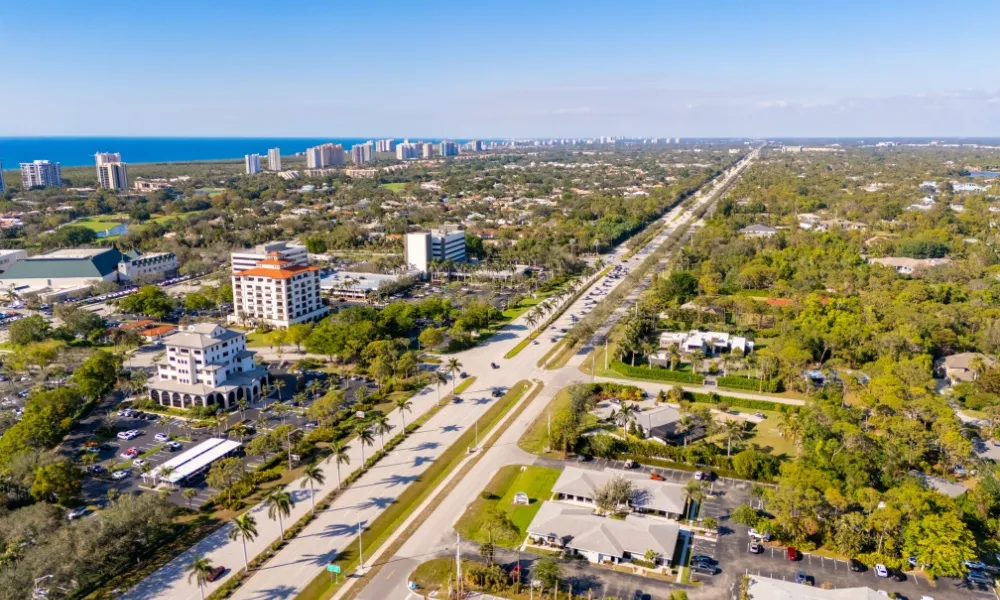


Naples, Florida, sits at the southern tip of the Gulf Coast, a city better known for waterfront estates and golf courses than warehouses and repair yards. But behind the luxury veneer, a quieter economy hums along – one that needs places to store equipment, fix trucks, and move goods. That economy is running out of room.
Industrial rents in Naples have climbed from roughly $10 per square foot a decade ago to $24 per square foot today, a tripling that reflects years of sluggish supply growth against steady demand. Vacancy sits at one to two percent, leaving tenants with little leverage and few alternatives.
Now, according to William Poteet, broker and owner of Poteet Properties, Inc., with three decades in Collier County commercial real estate, the situation is about to worsen. The county is allowing land zoned for heavy commercial use to be converted to high-end residential development, with no clear plan to replace what’s being lost.
A Decade of Increases
Naples industrial rents have followed a straightforward trajectory: constrained supply meeting persistent demand. Vacancy rates sit at roughly one to two percent, and new construction has not kept pace with the county’s population growth. Tenants have little leverage, and owners can command rates that would have seemed implausible ten years ago.
“The rates are somewhere in the $24 a square foot for industrial, which is really high,” Poteet says. “Used to be 10 years ago, $10 a square foot.”
That tripling over a decade reflects more than inflation or regional growth. It points to a failure to designate and develop enough new space to keep up with demand. Poteet says Collier County has not done enough planning to address the shortage, and the problem is now being compounded by an active pattern of rezoning that is removing existing industrial-zoned land from the market entirely.
The C5 Conversion Problem
The most concrete example is a stretch along Davis Boulevard, currently designated for heavy commercial use – the category that accommodates businesses like truck repair shops, equipment storage yards, and logistics operations. In county planning documents, this is called C5 zoning, and that corridor is being systematically absorbed by high-end residential development, with each successful residential project making the next conversion more likely. “The more they are successful in the high-end residential, the more likely those areas are going to be absorbed and reconverted and redeveloped,” Poteet says.
Poteet frames this as a legitimate economic outcome for Collier County in terms of property values and the tax base, but argues that it creates a functional gap that the county has not addressed. C5 zoning serves businesses that cannot operate in standard retail or office environments – businesses that every functioning economy depends on, but that tend to be invisible until they disappear. “Where do you get your trucks repaired?” Poteet asks. “There are certain businesses that have to be within C5, and so we need to replace that somewhere.”
The county, in Poteet’s view, has not identified where that replacement zoning will go. Without a deliberate planning response, the businesses that depend on C5 designations may find themselves priced out of Collier County entirely, forced into neighboring markets with lower land costs but also lower customer density.
Impact on Investors and Tenants
The disappearance of this zoning category without replacement creates a paradox for investors. On one hand, it further constrains supply in an already tight market, supporting continued rent growth and low vacancy for existing properties. On the other hand, it signals a county planning environment that may not welcome new industrial development, making it difficult to build into the shortage even for well-funded developers.
Poteet says the market has shown some slowdown compared to the prior year, though he attributes that more to broader economic uncertainty than to any change in underlying demand. The need for industrial space in Naples has not diminished – it has simply become harder to satisfy.
For tenants, the picture is more straightforward and more difficult. Businesses that need this type of space in Collier County face a shrinking pool of options and rising rents with no near-term relief in sight. Some may follow the path of tenants who have relocated to Fort Myers, where land costs and rents are lower. But for businesses that depend on proximity to Naples’ customer base, that trade-off may not be viable.
Where Opportunity Still Exists
Despite the supply constraints, or perhaps because of them, industrial properties remain one of the most active areas in Poteet’s practice. He has focused heavily on leasing and sales over the past two years, and says the combination of low vacancy and rising rents makes well-located industrial buildings among the most defensible investments in the Naples market.
His advice for investors is to focus on underserved growth corridors within the county where land can still be acquired at reasonable prices before residential conversion pressure arrives. “We have a definite shortage of industrial properties, and there isn’t a lot of planning by Collier County right now to increase that type of industrial,” Poteet says.
The broader question for Collier County is whether the conversion of these corridors to residential use represents a considered trade-off or an oversight. If the county does not identify replacement land for heavy commercial uses, the businesses and workers who depend on them may find that Naples’ prosperity has quietly made no room for them. The next few years of zoning decisions will determine whether the county’s industrial economy can function – or whether it gets pushed entirely across county lines.
About the Expert: William Poteet is a Broker and Owner of Poteet Properties, Inc., with three decades of experience in commercial real estate across Naples and Collier County, Florida. His firm focuses primarily on retail, office, and industrial sectors.
This article is intended for informational purposes only and does not constitute legal, financial, or investment advice. The views and opinions expressed herein reflect those of the individuals quoted and do not represent an endorsement of any company, product, or service mentioned. Readers should conduct their own due diligence and consult qualified professionals before making any investment decisions.